Zenobia
Empress of Palmyra in 272
| Zenobia 𐡡𐡶𐡦𐡡𐡩 | |
|---|---|
| Augusta | |
 Zenobia as empress on the obverse of an antoninianus (272 AD) | |
| Empress of Palmyra | |
| Reign | 272 AD |
| Co-monarch | Vaballathus |
| Queen of Egypt | |
| Reign | 270–272 |
Septimia Zenobia (Palmyrene Aramaic: 𐡡𐡶𐡦𐡡𐡩, romanized: Bat-Zabbai; c. 240 – c. 274) was a third-century queen of the Palmyrene Empire in Syria. Many legends surround her ancestry; she was probably not a commoner. She married Odaenathus, who became king of the city of Palmyra in 260, elevating it to supreme power in the Near East by defeating the Sasanian Empire of Persia and stabilizing the Roman East. After Odaenathus' assassination in 267, Zenobia became the regent of her son Vaballathus and held de facto power throughout his reign (267 to 272).
In 270, Zenobia launched an invasion that brought most of the Roman East under her sway and culminated with the annexation of Egypt. By mid-271 her realm extended from Ancyra, central Anatolia, to Upper Egypt, although she remained nominally subordinate to Rome. However, in reaction to the campaign of the Roman emperor Aurelian in 272, Zenobia declared her son emperor and assumed the title of empress, thus declaring Palmyra's secession from Rome. The Romans were victorious after heavy fighting; the empress was besieged in her capital and captured in late 272 by Aurelian, who exiled her to Rome, where she spent the remainder of her life.
Zenobia was a cultured monarch and fostered an intellectual environment in her court, which was open to scholars and philosophers. She was tolerant toward her subjects and protected religious minorities. The empress maintained a stable administration, which governed a multicultural, multiethnic empire. Zenobia died after 274, and many tales have been recorded about her fate. Her rise and fall have inspired historians, artists and novelists, and she is a patriotic symbol in Syria.
Name, appearance and sources
Zenobia was born c. 240–241, and bore the gentilicium (surname) Septimia. Her native Palmyrene name was Bat-Zabbai (written "Btzby" in the Palmyrene alphabet), an Aramaic name meaning "daughter of Zabbai". Such compound names for women were common in Palmyra, where the element "bt" means daughter, but the personal name that follows does not necessarily denote the immediate father, rather referring to the ancestor of the family. In Greek—Palmyra's diplomatic and second language, used in many Palmyrene inscriptions—she used the name Zenobia. In Palmyra, when written in Greek, names such as Zabeida, Zabdila, Zabbai or Zabda were often transformed into "Zenobios" (masculine) and "Zenobia" (feminine). The element "Zabbai" from Zenobia's native name means "gift of N.N. [god]", and the name Zenobia translates to "one whose life derives from Zeus". The historian Victor Duruy believed that the queen used the Greek name as a translation of her native name, in deference to her Greek subjects. The philologist Wilhelm Dittenberger argued that the name Bat-Zabbai underwent a detortum (twist), thus resulting in the name Zenobia.
The ninth-century historian al-Tabari, in his highly fictionalized account, wrote that the queen's name was Na'ila al-Zabba'. Manichaean sources, reporting the visit of the apostle Mar Adda to the region during the time of Odaenathus, called Zenobia "Queen Tadi", wife of kysr (caesar). The name given to Zenobia in those Manichaean writings seems to derive from Tadmor, Palmyra's native name, and this is supported by the Coptic Acts Codex, in which Zenobia is named Queen Thadmor.
No contemporary statues of Zenobia have been found in Palmyra or elsewhere, with only inscriptions on statues' bases surviving, indicating that a statue of the queen once stood in the place; most known representations of Zenobia are the idealized portraits of her found on her coins. Sculptures of Palmyrene style were normally impersonal, unlike Greek and Roman ones: a statue of Zenobia in this style would have given an idea of her general style in dress and jewelry but would not have revealed her true appearance. The non-contemporary historian Edward Gibbon has described her as being "of a dark complexion" and considered "most lovely," and that she "equalled in beauty her [claimed] ancestor Cleopatra." British scholar William Wright visited Palmyra toward the end of the nineteenth century in a vain search for a sculpture of the queen.
In addition to archaeological evidence, Zenobia's life was recorded in different ancient sources but many are flawed or fabricated; the Historia Augusta, a late-Roman collection of biographies, is the most notable (albeit unreliable) source for the era. The author (or authors) of the Historia Augusta invented many events and letters attributed to Zenobia in the absence of contemporary sources. Some Historia Augusta accounts are corroborated from other sources, and are more credible. The Byzantine chronicler Joannes Zonaras is considered an important source for the life of Zenobia.
Origin, family and early life
Palmyrene society was an amalgam of Semitic-speaking peoples, mostly Arabs and Arameans, and Zenobia cannot be identified with any one group; as a Palmyrene, she may have had both Arab and Aramean ancestry. Information about Zenobia's ancestry and immediate family connections is scarce and contradictory. Nothing is known about her mother, and her father's identity is debated. Manichaean sources mention a "Nafsha", sister of the "queen of Palmyra", but those sources are confused and "Nafsha" may refer to Zenobia herself: it is doubtful that Zenobia had a sister.
Apparently not a commoner, Zenobia would have received an education appropriate for a noble Palmyrene girl. The Historia Augusta contains details of her early life, although their veracity is dubious; according to the Historia Augusta, the queen's hobby as a child was hunting and, in addition to her Palmyrene Aramaic mother tongue, she was fluent in Egyptian and Greek and spoke Latin. When she was about fourteen years old (ca. 255), Zenobia became the second wife of Odaenathus, the ras ("lord") of Palmyra. Noble families in Palmyra often intermarried, and it is probable that Zenobia and Odaenathus shared some ancestors.
Contemporary epigraphical evidence
Basing their suppositions upon archaeological evidence, various historians have suggested several men as Zenobia's father:
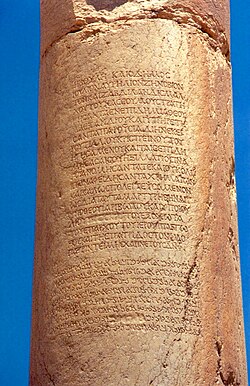
Julius Aurelius Zenobius appears on a Palmyrene inscription as a strategos of Palmyra in 231–232; based on the similarity of the names, Zenobius was suggested as Zenobia's father by the numismatist Alfred von Sallet and others. The archaeologist William Waddington argued in favor of Zenobius' identification as the father, assuming that his statue stood opposite to where the statue of the queen stood in Great Colonnade. However, the linguist Jean-Baptiste Chabot pointed out that Zenobius' statue stood opposite to that of Odaenathus not Zenobia and rejected Waddington's hypothesis. The only gentilicium, a hereditary name borne by people that was originally the name of one's gens (family or clan) by patrilineal descent, appearing on Zenobia's inscriptions was "Septimia" (not "Julia Aurelia", which she would have borne if her father's gentilicium was Aurelius), and it cannot be proven that the queen changed her gentilicium to Septimia after her marriage.
One of Zenobia's inscriptions recorded her as "Septimia Bat-Zabbai, daughter of Antiochus". Antiochus' identity is not definitively known: his ancestry is not recorded in Palmyrene inscriptions, and the name was not common in Palmyra. This, combined with the meaning of Zenobia's Palmyrene name (daughter of Zabbai), led scholars such as Harald Ingholt to speculate that Antiochus might have been a distant ancestor: the Seleucid king Antiochus IV Epiphanes or Antiochus VII Sidetes, whose wife was the Ptolemaic Cleopatra Thea. In the historian Richard Stoneman's view, Zenobia would not have created an obscure ancestry to connect herself with the ancient Macedonian rulers: if a fabricated ancestry were needed, a more direct connection would have been invented. According to Stoneman, Zenobia "had reason to believe [her Seleucid ancestry] to be true". The historian Patricia Southern, noting that Antiochus was mentioned without a royal title or a hint of great lineage, believes that he was a direct ancestor or a relative rather than a Seleucid king who lived three centuries before Zenobia.
On the basis of Zenobia's Palmyrene name, Bat Zabbai, her father may have been called Zabbai; alternatively, Zabbai may have been the name of a more distant ancestor. The historian Trevor Bryce suggests that she was related to Septimius Zabbai, Palmyra's garrison leader, and he may even have been her father. The archaeologist Charles Simon Clermont-Ganneau, attempting to reconcile the meaning of the name "Bat Zabbai" with the inscription mentioning the queen as daughter of Antiochus, suggested that two brothers, Zabbai and Antiochus, existed, with a childless Zabbai dying and leaving his widow to marry his brother Antiochus. Thus, since Zenobia was born out of a levirate marriage, she was theoretically the daughter of Zabbai, hence the name.
Ancient sources
In the Historia Augusta, Zenobia is said to have been a descendant of Cleopatra and claimed descent from the Ptolemies. According to the Souda, a tenth-century Byzantine encyclopedia, after the Palmyrene conquest of Egypt, the sophist Callinicus of Petra wrote a ten-volume history of Alexandria dedicated to Cleopatra. According to modern scholars, by Cleopatra Callinicus meant Zenobia. Apart from legends, there is no direct evidence in Egyptian coinage or papyri of a contemporary conflation of Zenobia with Cleopatra. The connection may have been invented by Zenobia's enemies to discredit her, but circumstantial evidence indicates that Zenobia herself made the claim; an imperial declaration once ascribed to Emperor Severus Alexander (died 235) was probably made by Zenobia in the name of her son Vaballathus, where the king named Alexandria "my ancestral city", which indicates a claim to Ptolemaic ancestry. Zenobia's alleged claim of a connection to Cleopatra seems to have been politically motivated, since it would have given her a connection with Egypt and made her a legitimate successor to the Ptolemies' throne. A relationship between Zenobia and the Ptolemies is unlikely, and attempts by classical sources to trace the queen's ancestry to the Ptolemies through the Seleucids are apocryphal.
Arab traditions and al-Zabba'
Although some Arab historians linked Zenobia to the Queen of Sheba, their accounts are apocryphal. Medieval Arabic traditions identify a queen of Palmyra named al-Zabba', and her most romantic account comes from al-Tabari. According to al-Tabari, she was an Amalekite; her father was 'Amr ibn Zarib, an 'Amālīq sheikh who was killed by the Tanukhids. Al-Tabari identifies a sister of al-Zabba' as "Zabibah". Jadhimah ibn Malik, the Tanukhid king who killed the queen's father, was killed by al-Zabba'. According to al-Tabari, al-Zabba' had a fortress along the Euphrates and ruled Palmyra.
Al-Tabari's account does not mention the Romans, Odaenathus, Vaballathus or the Sassanians; focusing on the tribes and their relations, it is immersed in legends. Although the account is certainly based on the story of Zenobia, it is probably conflated with the story of a semi-legendary nomadic Arab queen (or queens). Al-Zabba''s fortress was probably Halabiye, which was restored by the historic Palmyrene queen and named Zenobia.
Queen of Palmyra
Consort

During the early centuries AD, Palmyra was a city subordinate to Rome and part of the province of Syria Phoenice. In 260 the Roman emperor Valerian marched against the Sassanid Persian monarch Shapur I, who had invaded the empire's eastern regions; Valerian was defeated and captured near Edessa. Odaenathus, formally loyal to Rome and its emperor Gallienus (Valerian's son), was declared king of Palmyra. Launching successful campaigns against Persia, he was crowned King of Kings of the East in 263. Odaenathus crowned his eldest son, Herodianus, as co-ruler. In addition to the royal titles, Odaenathus received many Roman titles, most importantly corrector totius orientis (governor of the entire East), and ruled the Roman territories from the Black Sea to Palestine. In 267, when Zenobia was in her late twenties or early thirties, Odaenathus and his eldest son were assassinated while returning from a campaign.
The first inscription mentioning Zenobia as queen is dated two or three years after Odaenathus' death, so exactly when Zenobia assumed the title "queen of Palmyra" is uncertain. However, she was probably designated as queen when her husband became king. As queen consort, Zenobia remained in the background and was not mentioned in the historical record. According to later accounts, including one by Giovanni Boccaccio, she accompanied her husband on his campaigns. If the accounts of her accompanying her husband are true, according to Southern, Zenobia would have boosted the morale of the soldiers and gained political influence, which she needed in her later career.
Content from Wikipedia, available under CC BY-SA 4.0. Read on Wikipedia
Read today's article