Loveday (1458)
Arbitration event during the Wars of the Roses
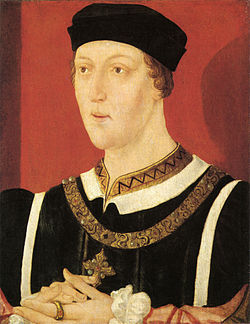
A loveday was held at St Paul's Cathedral on 25 March 1458 (Annunciation Day) to ritually reconcile the warring factions of the English nobility. Following the outbreak of the Wars of the Roses in 1455, it was the culmination of lengthy negotiations initiated by King Henry VI to resolve the lords' rivalries. English politics had become increasingly factional during his reign, and the situation was exacerbated in 1453 when the King became catatonic. This effectively left the government leaderless, and eventually the king's cousin, and at the time heir to the throne, Richard, Duke of York, was appointed protector during the king's illness. Alongside York were his allies from the politically and militarily powerful Neville family, led by Richard, Earl of Salisbury, and his eldest son, Richard, Earl of Warwick. When the king returned to health a year later, the protectorship ended but partisanship within the government did not.
Supporters of King Henry and his wife, Queen Margaret, were loosely called "Lancastrians", the king being head of the House of Lancaster, while the duke and his party were considered "Yorkists", after his title of Duke of York. By the 1450s, York felt increasingly excluded from government, and in May 1455—possibly fearing an ambush by his enemies—led an army against the King at the First Battle of St Albans. There, in what has been called more of a series of assassinations than a battle, the personal enemies of York and the Nevilles—the Duke of Somerset, the Earl of Northumberland, and Lord Clifford—perished.
In 1458 the king attempted to unite his feuding nobles with a public display of friendship under the auspices of the Church at St Paul's Cathedral. Following much discussion and negotiation, and amid the presence of large, armed, noble retinues which almost led to another outbreak of war, a compromise was announced. To celebrate, a procession was held by all the major participants, who walked hand-in-hand from Westminster Palace to the cathedral. Queen Margaret was partnered with York, and other adversaries were paired off accordingly, and the sons of the dead Lancastrian lords took their fathers' places. Certain reparations were ordained, all by the Yorkist lords, who for their part accepted full responsibility for the Battle of St Albans. They were ordered to make payments to the dead lords' widows and sons, and masses were paid for the souls of all who had died. Contemporaries varied in their views of the accord. Some wrote verses expressing hope that it would lead to a new-found peace and prosperity; others were more pessimistic as to its value.
In the long run, the king's Loveday and its agreements had no long-lasting benefit. Within a few months, petty violence between the lords had broken out again and, within the year, the Houses of York and Lancaster faced each other at the Battle of Blore Heath. Historians debate who—if anyone—gained from the 1458 Loveday. On the one hand, the crown publicised its role as the ultimate court of appeal but, conversely, although the Yorkists were bound to pay large sums in compensation, this was done with money already owed by the government. Fundamentally, factional discord was highlighted on the public stage, and the war it was intended to prevent was only deferred.
Political background
By the middle of the 15th century, English politics had become increasingly factional. Richard, Duke of York and his Neville allies—Richard, Earl of Salisbury and his son, Richard, Earl of Warwick, with their cousin John Mowbray, Duke of Norfolk—were in opposition to the government of King Henry VI. The king was weak-willed and easily led, and his government was effectively controlled by his favourite, Edmund Beaufort, Duke of Somerset. Further weakening the government, King Henry had become mentally incapacitated in August 1453, becoming comatose, unable to feed himself or recognise any of his companions.
At the time, a major feud was taking place in the North of England between the powerful Percy and Neville families. The former was led by Henry Percy, Earl of Northumberland's son, Thomas Percy, Lord Egremont, while the Neville family was headed by Salisbury. In March 1454, the king still being ill, Parliament authorised a protectorate to rule in the king's stead. The House of Lords chose the Duke of York—as the king's closest adult relative—as Protector. York and the Nevilles cemented an alliance during the protectorate when York appointed Salisbury his Lord Chancellor. York's protectorate had given the Nevilles a useful advantage over their rivals, and in November 1454, Thomas Percy and his brothers, Henry and Ralph, were captured in battle. They received massive fines. The following January, the king regained his health, and York was no longer required as Protector. York and the Nevilles retreated to their northern estates, and Mowbray did likewise to East Anglia, in an attempt to distance themselves from factional politics. From this point, argues the medievalist A. J. Pollard, power "shifted back into the hands of [York's] enemies, now given a lead by the Queen", Margaret of Anjou, rather than the king.
Yorkist demands

An uneasy peace existed between the court and the Yorkists until April 1455, when the king summoned a great council to meet at Leicester the following month. The Duke of York feared that the purpose of this council was to destroy him; several chroniclers of the day suggest that Somerset was influencing the king against the Duke with "subtile meanes". York and the Nevilles raised an army from their northern estates. They wrote to Henry regarding their fears, and emphasised their loyalty to him. This was in spite of what they called the "doubtes and ambiguitees [and] jealousie" spread by their enemies. The Yorkist lords also expressed their fears that their lives were in danger from those who hid "undre the wynge of your Mageste Roiall". This, they said, was the reason they felt the need to travel accompanied by large retinues. The Yorkists' solution was that the king dismiss those who kept the king's true liegemen (i.e., them) from him and that the malicious advisers be excommunicated by the Archbishop of Canterbury.
It is unknown whether the king received the Yorkist lords' letters, although the historian Michael Hicks believes that "there is no convincing evidence" that he did not. Henry and a small force left London for Leicester on 20 May; while it was natural for both the king and his followers to travel with armed contingents, the majority were members of their civil households. The Yorkists approached from the north with a speed calculated to surprise. In a pre-emptive strike, York and his allies intercepted the royal army at St Albans. Fighting in the streets lasted only a short time, and though there were very few fatalities among the common soldiery, the chief Lancastrian captains—Northumberland, Somerset and Thomas, Lord Clifford—were all killed. Not only were they three of the king's most loyal and powerful supporters, but Northumberland and Somerset were bitter enemies of the Nevilles and York. Because of this, the clash has been described more akin to a series of targeted assassinations than a fully fledged battle. On the 22nd, Henry was escorted, under guard, back to London: "all honour was shown to him" by York, Salisbury and Warwick, notes Griffiths, and a ceremony—intending to establish the new-found friendship between the king and the Yorkists—was held in St Paul's the following day.
The period between St Albans and the Loveday, says Pollard, is one of the most poorly recorded of the entire century, although what is known has enabled historians to piece together the basic chronology. By 1458, Henry's government urgently needed to deal with the unfinished problem that the Battle of St Albans had created, summarised by the scholar Ralph A. Griffiths as the "craving of the younger magnates for revenge on those who had killed their fathers". But Henry also wanted to bring the Yorkists back into the fold. Taking the initiative, the Loveday was intended to be his personal contribution to a lasting peace. Another motive for achieving a united magnatial front was the French: intelligence had been received suggesting they planned to attack Calais. In the event, this never occurred, but the previous year the French had been able to land at Sandwich in Kent, which they sacked, taking many prisoners. This alone was reason enough to bring the warring parties together. The Yorkists released an official statement, known as the Parliamentary Pardon, which was intended to absolve them of blame for the crisis. This, as the name suggests, was passed by act of parliament, and was seen as a stronger defence for the Yorkists than one issued by the king alone.
Lovedays as arbitration
In 'loveday', 'love' meant concord or a settlement, and 'day' as a legal term meant a case-opening rather than a twenty-four hour period. There were few, if any restrictions on the kind of business that a loveday could address, as long as the court had authorised it, and this included cases that were pending at a higher court. Arbitration, argues legal historian Anthony Musson, was not a resource restricted to one particular group of people, rather a universal phenomenon, occurring at every level and among all orders of society".
Mechanics
The ritualistic reconciliations that contemporaries called lovedays have been described by the scholar B. P. Wolffe as "a formal accord on the limited issue of atonement and compensation". Legal historian John Baker suggested that, in particularly contentious affairs, a loveday was deliberately designed "to avoid reasoned decision making", being intended to result in voluntary—therefore amicable—settlements. This was regardless of who was legally in the right. The process often had a social aspect to it, such as the parties having to worship or dine together. Lovedays were particularly favoured among the nobility as a mechanism by which parties could avoid the involvement of the crown if they wished. Held in neutral locations agreeable to the protagonists, lovedays were arranged by people acting as the protagonists' councillors. These would be important men in the extra-legal process, says Griffiths: "anyone who talked or wrote about or organized these dies amories was half-way towards settling potentially dangerous quarrels". The protagonists would usually arrive accompanied by small retinues and await an award from the arbitration committee. This normally comprised three men, trusted by all those involved, and usually members of the local nobility or respected local gentry. Often one of them would be appointed at the beginning of the process as an umpire, in case of a deadlock.
Preparations and negotiations
Summoning the lords
The Lancastrians were well placed to harry the Yorkists as they made their way to Westminster for the great council. On 1 March, Warwick was warned that Somerset and Northumberland planned to avenge St Albans there and then, but the earl refused to be deterred from attending the council meeting. Some were evidently persuaded only with difficulty to await the king's award.
King Henry believed that an organised settlement, under his leadership, could be made between the opposing factions. Several great councils were called in late 1457, involving long and protracted negotiations between the parties. Henry eventually summoned a great council to Westminster, with the intent of eventually imposing his own arbitration award. The summons told how the king wished "to set apart such variances as be betwixt divers lords". This council was scheduled to meet in November 1457, but it received little interest from the nobility, only a few turning up. Among those who did were York and Salisbury, although the latter had been escorted—willingly or not is unknown—from Doncaster by Viscount Beaumont. The little that is known of this council stems from subsequent writs which simultaneously cancelled and reformed it. The council was rescheduled for 27 January 1458 and, this time, it appears to have been more positively received. Lords began arriving in London a few days before it was due to start. Each arrived with their retinues, which in the cases of the main protagonists involved substantial bodies of men.
Content from Wikipedia, available under CC BY-SA 4.0. Read on Wikipedia
Read today's article