Three Studies for Figures at the Base of a Crucifixion
1944 triptych by Francis Bacon
| Three Studies for Figures at the Base of a Crucifixion | |
|---|---|
 | |
| Artist | Francis Bacon |
| Year | 1944 |
| Type | Oil paint and pastel on fibre board |
| Dimensions | 94 cm × 74 cm (37 in × 29 in) |
| Location | Tate Britain, London |
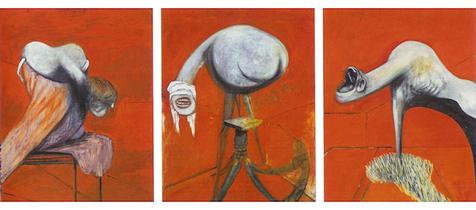
Three Studies for Figures at the Base of a Crucifixion is a 1944 triptych painted by the Irish-born British artist Francis Bacon. The canvasses are based on the Eumenides—or Furies—of Aeschylus's Oresteia, and depict three writhing anthropomorphic creatures set against a flat burnt orange background. It was executed in oil paint and pastel on Sundeala fibre board and completed within two weeks. The triptych summarises themes explored in Bacon's previous work, including his examination of Picasso's biomorphs and his interpretations of the crucifixion and the Greek Furies. Bacon did not realise his original intention to paint a large crucifixion scene and place the figures at the foot of the cross.
The Three Studies are generally considered Bacon's first mature piece; he regarded his works before the triptych as irrelevant, and throughout his life tried to suppress their appearance on the art market. When the painting was first exhibited in 1945 it caused a sensation and established him as one of the foremost post-war painters. Remarking on the cultural significance of Three Studies, the critic John Russell observed in 1971 that "there was painting in England before the Three Studies, and painting after them, and no one ... can confuse the two".
Background
Francis Bacon painted sporadically and without commitment during the late 1920s and early 1930s, when he worked as an interior decorator and designer of furniture and rugs. He later said that his career was delayed because he had spent so long looking for a subject that would sustain his interest. He began to paint images based on the Crucifixion of Jesus in 1933, when his then-patron Eric Hall commissioned a series of three paintings based on the subject. These abstract figurations contain formal elements typical of their time, including diaphanous forms, flat backgrounds, and surrealist props such as flowers and umbrellas. The art critic Wieland Schmied noted that while the early works are "aesthetically pleasing", they lack "a sense of urgency or inner necessity; they are beautiful, but lifeless". The sentiment is echoed by Hugh Davies, who wrote that Bacon's 1933 paintings "suggest an artist concentrating more on formal than on expressive concerns". Bacon admitted that his early works were not successful; they were merely decorative and lacking in substance. He was often harshly self-critical during this period, and would abandon or destroy canvasses before they were completed. He abandoned the Crucifixion theme, then largely withdrew from painting in frustration, instead immersing himself in love affairs, drinking and gambling.
When he returned to the topic of the Crucifixion eleven years later, he retained some of the stylistic elements he had developed earlier, such as the elongated and dislocated organic forms that he now based on Oresteia. He continued to incorporate the spatial device he was to use many times throughout his career—three lines radiating from this central figure, which was first seen in Crucifixion. Three Studies was painted over the course of two weeks in 1944 when, Bacon recalled, "I was in a bad mood of drinking, and I did it under tremendous hangovers and drink; I sometimes hardly knew what I was doing. I think perhaps the drink helped me to be a bit freer." The painting was executed in a ground-floor flat at 7 Cromwell Place, South Kensington in London. A large back room in the building had been converted into a billiard room by its previous occupant, artist John Everett Millais. It was Bacon's studio by day; at night, abetted by Eric Hall and Bacon's childhood nanny Jessie Lightfoot, it functioned as an illicit casino.
Although he had been painting for almost twenty years, Bacon steadfastly insisted that Three Studies was the fons et origo of his career. He destroyed many of his earlier canvases and tried to suppress those that had left his studio. Bacon was emphatic that no pre-1944 images be admitted into his canon, and most of the early art critics agreed with this position. The early publications of John Russell and David Sylvester open with the 1944 triptych, and Bacon insisted to his death that no retrospective should feature paintings pre-dating 1944.
Triptych
The panels of Three Studies for Figures at the Base of a Crucifixion are painted on light Sundeala boards, a material Bacon was using at the time as an inexpensive alternative to canvas. Each bears a single taut sculptural form pitched against a harsh orange background. The orange hue displays inconsistently across the canvases, due in part to the low level of oil in the paint, which resulted in varying rates of absorption into the board. The pallid flesh tones of the figures were achieved by overlaying grey and white brushstrokes, while the figures' props were coloured using a variety of yellow, green, white, and purple tones.

The art critic Hugh Davies has suggested that of the three figures, that on the left most closely resembles a human form, and that it might represent a mourner at the cross. Seated on a table-like structure, this limbless creature has an elongated neck, heavily rounded shoulders, and a thick mop of dark hair. Like its affiliate objects, the left-hand figure is portrayed with layers of white and grey paint.
The central figure's mouth is positioned directly on its neck, rather than on a distinct face. It bares its teeth as if in a snarl, and is blindfolded by a drooping cloth bandage—a device likely drawn from Matthias Grünewald's Mocking of Christ. This creature faces the viewer directly and is centralised by a series of converging lines radiating from the base of the pedestal.
Situated on an isolated patch of grass, the right-hand figure's toothed mouth is stretched open as if screaming, although David Sylvester has suggested that it may be yawning. Its mouth is open to a degree impossible for a human skull. The orange background of this panel is brighter than the hues rendered in the other frames, and the figure's neck opens up into a row of teeth, while a protruding ear juts out from behind its lower jaw. This panel closely resembles an earlier painting by Bacon, Untitled, c. 1943, which was thought destroyed until it re-emerged in 1997.
Inspection under infrared has revealed that the panels were heavily reworked during several revisions. The legs of the central figure are surrounded by small magenta horseshoe shapes, which infrared shows to have been first drafted as flowers. The area below the head is thickly coated with white and orange paint, while the inspection exposes a series of underlying curved brushstrokes used to compose a landscape, and a small distant reclining figure. When the canvas is unframed, measuring marks are visible on the outer margin of board, indicating that the composition was carefully conceived.
Bacon said in a 1959 letter that the figures in Three Studies were "intended to [be] use[d] at the base of a large Crucifixion which I may still do". By this, Bacon implied that the figures were conceived as a predella to a larger altarpiece. The biographer Michael Peppiatt has suggested that the panels may have emerged as single works, and that the idea of combining them as a triptych came later. There is little in the themes or styles of the three panels to suggest that they were originally conceived as a whole. Though they share the same orange background, Bacon had already used this colour in two prior pieces; moreover, his oeuvre can be characterised by periods that are dominated by a single background colour. From the beginning of his career, Bacon preferred to work in series and found that his imagination was stimulated by sequences; as he put it, "images breed other images in me."
The Crucifixion itself is conspicuously absent, and there is no trace or shadow of its presence in the panels. Writing in 1996, Wieland Schmied noted that the three Furies have replaced Christ and the two thieves crucified on either side of him. The form of the Furies is borrowed directly from Picasso's late 1920s and mid-1930s pictures of biomorphs on beaches, in particular from the Spanish artist's The Bathers (1937). However, the eroticism and comedy of Picasso's figures have been replaced by a sense of menace and terror derived in part from Matthias Grünewald's Mocking of Christ.
Themes and style

Three Studies for Figures at the Base of a Crucifixion is a key precursor to Bacon's later work, and he sustained its formal and thematic preoccupations throughout his career. The triptych format, the placement of figures behind glass in heavily gilded frames, the open mouth, the use of painterly distortion, the Furies, and the theme of the Crucifixion were all to reappear in later works. Bacon's principal mode of expression is introduced: the subjects are anatomically and physically distorted, and the mood is violent, foreboding, and relentlessly physical. In other respects the triptych stands apart from other paintings in his oeuvre. It refers directly to its inspirations, and interprets the source material in an uncharacteristically literal manner. The triptych is further distinct in that its creatures are located in an outside space; by 1948, Bacon's studies of heads and figures specifically emphasised their confinement in rooms or other closed spaces.
Although Bacon stated that he modelled the creatures on the Furies, the visual link to the sources is barely perceptible in his finished work. The mood and tone of the painting, however, is consistent with the agonised spirit of the Furies' legend. They are traditionally depicted as ancient chthonic deities preoccupied with avenging patricide and matricide by hunting down and killing violent criminals. In Aeschylus' The Oresteia, the title character is pursued by the Furies in revenge for the murder of his mother Clytemnestra. The saga tells the story of the decimation of the line of Atreus; Clytemnestra had hacked to death her husband Agamemnon, and later slew Cassandra, who had foreseen the murders and declared: "Drunken, drunken with blood / To make them dare the more, a reveling rout / Is in the rooms which no man shall cast out, of sister Furies."
Bacon did not seek to illustrate the narrative of the tale, however. He told the French art critic Michel Leiris, "I could not paint Agamemnon, Clytemnestra or Cassandra, as that would have been merely another kind of historical painting ... Therefore I tried to create an image of the effect it produced inside me." Aeschylus' phrase "the reek of human blood smiles out at me" in particular haunted Bacon, and his treatments of the mouth in the triptych and many subsequent paintings were attempts to visualise the sentiment. In 1985, he observed that Aeschylus' phrase brought up in him "the most exciting images, and I often read it ... the violence of it brings up the images in me, 'the reek of human blood smiles out at me', well what could be more amazing than that."
Bacon was introduced to Aeschylus through T. S. Eliot's 1939 play The Family Reunion, in which the protagonist Harry is haunted by "the sleepless hunters / that will not let me sleep". In Eliot's play, the Furies serve as embodiments of the remorse and guilt felt by Harry, who harbours a dark family secret, shared only with his sister. Bacon was captivated by Aeschylus' play, and keen to learn more about Greek tragedy, and said many times that he regretted being unable to read the original in Greek. In 1942, he read the Irish scholar William Bedell Stanford's Aeschylus in his Style, and found the theme of obsessive guilt in The Oresteia to be highly resonant. In 1984, Bacon told Sylvester that although his painting's subject matter did not have a direct relationship with the poet's work, for him Eliot's work "opened the valves of sensation".
The mouth of the triptych's central figure was also inspired by the nurse's scream in film director Sergei Eisenstein's Odessa Steps massacre sequence in The Battleship Potemkin (1925). In 1985, the broadcaster Melvyn Bragg confronted Bacon with a reproduction of the centre panel during the filming of a South Bank Show documentary, and observed that in his earlier career the artist seemed preoccupied with the physicality of the human mouth. Bacon replied, "I had always thought that I would be able to make the mouth with all the beauty of a Monet landscape though I never succeeded in doing so." When Bragg asked why he thought he had failed, Bacon admitted, "It should be all much more colour, should have got more of the interior of the mouth, with all the colours of the interior of the mouth, but I didn't happen to get it."
Content from Wikipedia, available under CC BY-SA 4.0. Read on Wikipedia
Read today's article