Apollo 6
1968 American Saturn V rocket test flight
 Launch of Apollo 6 (identifiable by its white-painted service module) as seen from the top of the launch tower | |
| Mission type | Uncrewed Earth orbital CSM flight (A) |
|---|---|
| Operator | NASA |
| COSPAR ID | 1968-025A |
| SATCAT no. | 3170 |
| Mission duration | 9 hours 57 minutes 20 seconds |
| Orbits completed | 3 |
Apollo 6 (April 4, 1968), also known as AS-502, was the third and final uncrewed flight in the United States' Apollo program and the second test of the Saturn V launch vehicle. The Saturn V's utilization during the mission qualified it for use during human spaceflight, and it was used beginning on Apollo 8 in December 1968.
Apollo 6 was intended to demonstrate the ability of the Saturn V's third stage, the S-IVB, to propel itself and the Apollo spacecraft to lunar distances. Its components began arriving at the Kennedy Space Center in early 1967. Testing proceeded slowly, often delayed by testing of the Saturn V intended for Apollo 4—the inaugural launch of the Saturn V. After that uncrewed mission launched in November 1967, there were fewer delays, but enough so that the flight was postponed from March to April 1968.
The flight plan called for, following trans-lunar injection, a direct return abort using the service module's main engine with a flight time totaling about 10 hours, but vibrations damaged some of the Rocketdyne J-2 engines in the second and third stages by rupturing internal fuel lines causing a second-stage engine to shut down early. An additional second-stage engine also shut down early due to cross-wiring with the engine that had shut down. The vehicle's onboard guidance system compensated by burning the second and third stages longer, although the resulting parking orbit was more elliptical than planned. The damaged third-stage engine failed to restart for trans-lunar injection. Flight controllers elected to repeat the flight profile of the previous Apollo 4 test, achieving a high orbit and high-speed return. Despite the engine failures, the flight provided NASA with enough confidence to use the Saturn V for crewed launches; a potential third uncrewed flight of the Saturn V was cancelled.
Objectives
Apollo 6, the second test flight of the Saturn V launch vehicle, was intended to send a command and service module (CSM) plus a Lunar Test Article (LTA), a simulated lunar module (LM) with mounted structural vibration sensors, into a trans-lunar trajectory, with the boost from orbit to trans-lunar velocity powered by the Saturn V's third stage, the S-IVB. That trajectory, although passing beyond the orbit of the Moon, would not encounter it. The CSM was to separate from the S-IVB soon after the burn, and the SM engine would then fire to slow the craft, dropping its apogee to 22204 km (11989 nmi) and causing the CSM to return to Earth, simulating a "direct-return" abort. On the return leg, the engine was to fire once more to accelerate the craft to simulate conditions that the Apollo spacecraft would encounter on its return from the Moon, with a re-entry angle of −6.5 degrees and velocity of 11100 m/s (36500 ft/s). The entire mission was to last about 10 hours.
The mission was intended to test the Saturn V launch vehicle's ability to send the entire Apollo spacecraft to the Moon—in particular, to test the stresses on the LM and the vibration modes of the entire Saturn V with near-full loads. With the spacecraft having been qualified for crewed flight through the Apollo 4 mission (the first flight of the Saturn V), the focus was on fully qualifying the launch vehicle. Nominal completion of planned mission events through attainment of the initial parking orbit, and the restarting of the S-IVB to propel the space vehicle towards the planned distance, beyond the Moon's orbit, was deemed sufficient to fulfill Apollo 6's main objectives.
Equipment

Apollo 6's launch vehicle was designated AS-502, the second flight-capable Saturn V. Its payload included CSM-020, a Block I CSM that had some Block II modifications. The Block I CSM did not have the capability of docking with a Lunar Module, as the Block II did. Among the modifications to CSM-020 was a new crew hatch, intended to be tested under lunar return conditions. This new hatch replaced the one which was condemned by the Apollo 1 investigation board as too difficult to open in case of emergency, circumstances that had contributed to the deaths of three astronauts in the Apollo 1 fire of January 27, 1967. The command module used was CM-020; it carried a mission programmer and other equipment to allow it to be operated remotely.
The service module used was SM-014—the originally-planned SM for Apollo 6, SM-020, was used for Apollo 4 after its SM, SM-017, was damaged in an explosion and had to be scrapped. CM-014 was unavailable for flight as it was being used to aid the Apollo 1 investigation. Not all SM systems were activated for the short Apollo 6 mission: the radiators to remove excess heat from the electrical power system and the environmental control system were not connected.
Kenneth S. Kleinknecht, Command and Service Module manager at the Manned Spaceflight Center in Houston, was pleased with CSM-020 when it arrived at Kennedy Space Center from North American Aviation, the manufacturer, though he was upset it arrived wrapped in flammable mylar. In contrast with Apollo 1's ill-fated CSM, which arrived with hundreds of unresolved issues, CSM-020 had only 23, mostly routine problems.
Also flown on Apollo 6 was a lunar test article: a simulated lunar module, designated as LTA-2R. It included a flight-type descent stage without landing gear, its fuel tanks filled with a water–glycol mixture and freon in its oxidizer tanks. Containing no flight systems, its ascent stage was made of ballasted aluminum and instrumented to show vibration, acoustics and structural integrity. LTA-2R remained inside the Spacecraft-Lunar Module Adapter, numbered SLA-9, throughout the flight.
Preparation
The S-IC first stage arrived by barge on March 13, 1967, and was erected in the Vehicle Assembly Building (VAB) four days later; the S-IVB third stage and Instrument Unit computer both arrived on March 17. The S-II second stage was not yet ready and so the dumbbell-shaped spacer, used in preparation for Apollo 4 (which also had a delayed S-II), was substituted so testing could proceed. The spacer had the same height and mass as the S-II along with all the electrical connections. The S-II arrived May 24 and was stacked and mated into the rocket on July 7.
Apollo 6 saw the first use of the High Bay 3 of the VAB, and it was quickly discovered that its air conditioning facilities were inadequate. Portable high-capacity units were brought in to keep equipment and workers cool. There were delays in April as personnel and equipment were busy with Apollo 4, and not available for tests on Apollo 6. The S-II second stage arrived on May 25 and was erected in one of the VAB's low bays, but work on Apollo 6 continued to be plagued by delays, many occasioned by work on Apollo 4. The vehicle was erected on Mobile Service Launcher 2, but work on the launcher's arms, which would swing back at launch, proceeded slowly. Also slow to arrive was the CSM itself; the planned late-September arrival was pushed back two months.
After Apollo 4's launch on November 9, 1967, the pace of the Apollo 6 project picked up, but there remained many problems with flight hardware. The CSM was erected atop the launch vehicle on December 11, 1967, and the spacecraft stack was rolled out to Launch Complex 39A on February 6, 1968. The rollout was an all-day affair, and much of it was conducted in heavy rain. Because the crawler-transporter had to halt for two hours when communications failed, the vehicle did not arrive at the launch pad until it was dark. The mobile service structure could not be moved to the launch pad for two days due to high winds.
The flight readiness test concluded on March 8, 1968, and at a review held three days later, Apollo 6 was cleared for launch contingent on the successful completion of testing and some action items identified at the meeting. Launch was set for March 28, 1968, but was postponed to April 1 and then April 3 after problems with some guidance system equipment and with fueling. The countdown demonstration test began on March 24; although it was completed within a week, the launch had to be postponed one more time. On April 3, the final countdown began with liftoff scheduled for the following day. All subsequent problems were fixed during the built-in holds in the countdown and did not delay the mission.
Flight
Launch
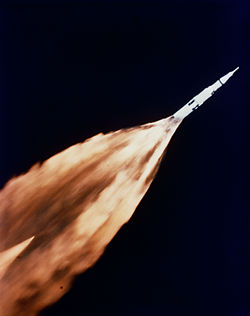
Apollo 6 launched from Launch Complex 39A at Kennedy Space Center on April 4, 1968, at 7:00:01 am EST (12:00 UTC). For the first two minutes, the Saturn V launch vehicle behaved normally. Then, as the Saturn V's S-IC first stage burned, pogo oscillations shook the vehicle. The thrust variations caused the Saturn V to experience a g-force of ±0.6 g (5.9 m/s2), though it had only been designed for a maximum of 0.25 g (2.5 m/s2). The vehicle suffered no damage, other than the loss of one of the panels of the Spacecraft-Lunar Module Adapter (SLA).
NASA Associate Administrator for Manned Space Flight George Mueller explained the cause to a hearing of the House Committee on Government Operations:
Pogo arises fundamentally because you have thrust fluctuations in the engines. Those are normal characteristics of engines. All engines have what you might call noise in their output because the combustion is not quite uniform, so you have this fluctuation in thrust of the first stage as a normal characteristic of all engine burning.
Now, in turn, the engine is fed through a pipe that takes the fuel out of the tanks and feeds it into the engine. That pipe's length is something like an organ pipe so it has a certain resonance frequency of its own and it really turns out that it will oscillate just like an organ pipe does.
The structure of the vehicle is much like a tuning fork, so if you strike it right, it will oscillate up and down longitudinally. In a gross sense it is the interaction between the various frequencies that causes the vehicle to oscillate.
After the first stage was jettisoned, the S-II second stage began to experience problems with its J-2 engines. Engine number two had performance problems from 225 seconds after liftoff, abruptly worsening at T+319 seconds. At T+412 seconds the Instrument Unit shut it down altogether, and two seconds later, engine number three also shut down. The fault was in engine two, but due to cross-connection of wires, the command from the Instrument Unit also shut down engine three, which had been running normally. The Instrument Unit was able to compensate, and the remaining three engines burned for 58 seconds longer than planned. The S-IVB third stage also had to burn for 29 seconds longer than usual. The S-IVB also experienced a slight performance loss.
Orbit
Due to the less-than-nominal launch, the CSM and S-IVB were inserted into a 173.14 km (93.49 nmi) by 360.10 km (194.44 nmi) parking orbit, instead of the planned 190 km (100 nmi) circular parking orbit. This deviation from the flight plan did not preclude continuing the mission. During the first orbit, the S-IVB maneuvered, changing its attitude towards the horizon to qualify techniques that future astronauts could use in landmark tracking. Then, after the standard two orbits to assess the vehicle's readiness for trans-lunar injection (TLI), the S-IVB was ordered to restart, but failed to do so.
Content from Wikipedia, available under CC BY-SA 4.0. Read on Wikipedia
Read today's article