Enzyme kinetics
Study of biochemical reaction rates catalysed by an enzyme
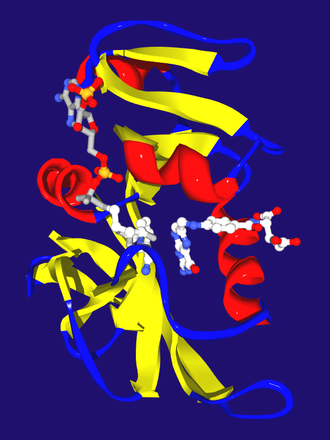
Enzyme kinetics is the study of the rates of enzyme-catalysed chemical reactions. In enzyme kinetics, the reaction rate is measured and the effects of varying the conditions of the reaction are investigated. Studying an enzyme's kinetics in this way can reveal the catalytic reaction mechanism of this enzyme, its role in metabolism, how its activity is controlled, and how a drug or a modifier (inhibitor or activator) might affect the rate.
An enzyme, often written "E" in reactions, is a protein molecule that serves as a biological catalyst to facilitate and accelerate a chemical reaction in a cell or other biological environment. It does this through binding of one or more other molecules, its substrate (S), which the enzyme acts upon to form the desired product. The substrate binds to the active site of the enzyme to produce an enzyme-substrate complex (ES), and is transformed into an enzyme-product complex (EP) and from there to the product or products (P), via a transition state (ES*). That series of steps is known as the mechanism:
- E + S ⇄ ES ⇄ ES* ⇄ EP ⇄ E + P
When enzymes bind multiple substrates, such as dihydrofolate reductase, enzyme kinetics can also show the sequence in which these substrates bind and the sequence in which products are released. An example of enzymes that bind a single substrate and release multiple products are proteases, which cleave one protein substrate into two polypeptide products. Others join two substrates together, such as DNA polymerase linking a nucleotide to DNA. Although these mechanisms are often a complex series of steps, there is typically one rate-determining step that determines the overall kinetics of the entire process. This step may be a chemical reaction or a conformational change of the enzyme or substrates, such as those involved in the release of product(s) from the enzyme.
Knowledge of the enzyme's structure is helpful in interpreting kinetic data. For example, the structure can suggest how substrates and products bind during catalysis; what changes occur during the reaction; and even the role of particular amino acid residues in the mechanism. Some enzymes change shape significantly during the mechanism; in such cases, it is helpful to determine the enzyme structure with and without bound substrate analogues that do not undergo the enzymatic reaction.
Not all biological catalysts are protein enzymes: RNA-based catalysts such as ribozymes and ribosomes are essential to many cellular functions, such as RNA splicing and translation. The main difference between ribozymes and enzymes is that RNA catalysts are composed of nucleotides, whereas enzymes are composed of amino acids. Ribozymes also perform a more limited set of reactions, although their mechanisms and kinetics can be analysed and classified by the same methods.
General principles


The reaction catalysed by an enzyme uses exactly the same reactants and produces exactly the same products as the uncatalysed reaction. Like other catalysts, enzymes do not alter the position of equilibrium between substrates and products. However, unlike uncatalysed chemical reactions, enzyme-catalysed reactions display saturation kinetics. For a given enzyme concentration and for relatively low substrate concentrations, the reaction rate increases linearly with substrate concentration; the enzyme molecules are largely free to catalyse the reaction, and increasing substrate concentration means an increasing rate at which the enzyme and substrate molecules encounter one another. However, at relatively high substrate concentrations, the reaction rate asymptotically approaches the theoretical maximum; the enzyme active sites are almost all occupied by substrates resulting in saturation, and the reaction rate is determined by the intrinsic turnover rate of the enzyme. The substrate concentration midway between these two limiting cases is denoted by KM. Thus, KM is the substrate concentration at which the reaction velocity is half of the maximum velocity.
The two important properties of enzyme kinetics are how easily the enzyme can be saturated with a substrate, and the maximum rate it can achieve. Knowing these properties suggests what an enzyme might do in the cell and can show how the enzyme will respond to changes in these conditions.
Enzyme assays
Enzyme assays are laboratory procedures that measure the rate of enzyme reactions. Since enzymes are not consumed by the reactions they catalyse, enzyme assays usually follow changes in the concentration of either substrates or products to measure the rate of reaction. There are many methods of measurement. Spectrophotometric assays observe the change in the absorbance of light between products and reactants; radiometric assays involve the incorporation or release of radioactivity to measure the amount of product made over time. Spectrophotometric assays are most convenient since they allow the rate of the reaction to be measured continuously. Although radiometric assays require the removal and counting of samples (i.e., they are discontinuous assays), they are usually extremely sensitive and can measure very low levels of enzyme activity. An analogous approach is to use mass spectrometry to monitor the incorporation or release of stable isotopes as the substrate is converted into product. Occasionally, an assay fails and approaches are essential to resurrect a failed assay.
The most sensitive enzyme assays use lasers focused through a microscope to observe changes in single enzyme molecules as they catalyse their reactions. These measurements either use changes in the fluorescence of cofactors during an enzyme's reaction mechanism, or of fluorescent dyes added onto specific sites of the protein to report movements that occur during catalysis. These studies provide a new view of the kinetics and dynamics of single enzymes, as opposed to traditional enzyme kinetics, which observes the average behaviour of populations of millions of enzyme molecules.
An example progress curve for an enzyme assay is shown above. The enzyme produces product at an initial rate that is approximately linear for a short period after the start of the reaction. As the reaction proceeds and substrate is consumed, the rate continuously slows (so long as the substrate is not still at saturating levels). To measure the initial (and maximal) rate, enzyme assays are typically carried out while the reaction has progressed only a few percent towards total completion. The length of the initial rate period depends on the assay conditions and can range from milliseconds to hours. However, equipment for rapidly mixing liquids allows fast kinetic measurements at initial rates of less than one second. These very rapid assays are essential for measuring pre-steady-state kinetics.
Most enzyme kinetics studies concentrate on this initial, approximately linear part of enzyme reactions. However, it is also possible to measure the complete reaction curve and fit this data to a non-linear rate equation. This way of measuring enzyme reactions is called progress-curve analysis. This approach is useful as an alternative to rapid kinetics when the initial rate is too fast to measure accurately.
The Standards for Reporting Enzymology Data guidelines provide minimum information required to comprehensively report kinetic and equilibrium data from investigations of enzyme activities including corresponding experimental conditions. The guidelines have been developed to report functional enzyme data with rigor and robustness.
Single-substrate reactions
Enzymes with single-substrate mechanisms include isomerases such as triosephosphateisomerase or bisphosphoglycerate mutase, intramolecular lyases such as adenylate cyclase, and the hammerhead ribozyme, an RNA lyase. However, some enzymes that only have a single substrate do not fall into this category of mechanisms. Catalase is an example of this, as the enzyme reacts with a first molecule of hydrogen peroxide substrate, becomes oxidised and is then reduced by a second molecule of substrate. Although a single substrate is involved, the existence of a modified enzyme intermediate means that the mechanism of catalase is actually a ping–pong mechanism, a type of mechanism that is discussed in the Multi-substrate reactions section below.
Michaelis–Menten kinetics
As enzyme-catalysed reactions are saturable, their rate of catalysis does not show a linear response to increasing substrate. If the initial rate of the reaction is measured over a range of substrate concentrations (denoted as [S]), the initial reaction rate () increases as [S] increases. However, as [S] gets higher, the enzyme becomes saturated with substrate and the initial rate reaches Vmax, the enzyme's maximum rate.
In the Michaelis–Menten kinetic model of a single-substrate reaction there is an initial bimolecular reaction between the enzyme E and substrate S to form the enzyme–substrate complex ES. The rate of enzymatic reaction increases with the increase of the substrate concentration up to a certain level called Vmax; at Vmax, increase in substrate concentration does not cause any increase in reaction rate as there is no more enzyme (E) available for reacting with substrate (S). Here, the rate of reaction becomes dependent on the ES complex and the reaction becomes a unimolecular reaction with an order of zero. Though the enzymatic mechanism for the unimolecular reaction can be quite complex, there is typically one rate-determining enzymatic step that allows this reaction to be modelled as a single catalytic step with an apparent unimolecular rate constant kcat. If the reaction path proceeds over one or several intermediates, kcat will be a function of several elementary rate constants, whereas in the simplest case of a single elementary reaction (e.g. no intermediates) it will be identical to the elementary unimolecular rate constant k2. The apparent unimolecular rate constant kcat is also called turnover number, and denotes the maximum number of enzymatic reactions catalysed per second.
The Michaelis–Menten equation describes how the (initial) reaction rate v0 depends on the position of the substrate-binding equilibrium and the rate constant k2.
- (Michaelis–Menten equation)
with the constants
This Michaelis–Menten equation is the basis for most single-substrate enzyme kinetics. Two crucial assumptions underlie this equation (apart from the general assumption about the mechanism only involving no intermediate or product inhibition, and there is no allostericity or cooperativity). The first assumption is the so-called quasi-steady-state assumption (or pseudo-steady-state hypothesis), namely that the concentration of the substrate-bound enzyme (and hence also the unbound enzyme) changes much more slowly than those of the product and substrate and thus the change over time of the complex can be set to zero.
.
The second assumption is that the total enzyme concentration does not change over time, thus
.
The Michaelis constant KM is experimentally defined as the concentration at which the rate of the enzyme reaction is half Vmax, which can be verified by substituting [S] = KM into the Michaelis–Menten equation and can also be seen graphically. If the rate-determining enzymatic step is slow compared to substrate dissociation (), the Michaelis constant KM is roughly the dissociation constant KD of the ES complex. If is small compared to then the term and also very little ES complex is formed, thus . Therefore, the rate of product formation is
Thus the product formation rate depends on the enzyme concentration as well as on the substrate concentration, the equation resembles a bimolecular reaction with a corresponding pseudo-second order rate constant . This constant is a measure of catalytic efficiency. The most efficient enzymes reach a in the range of 108 – 1010 M−1 s−1. These enzymes are so efficient they effectively catalyse a reaction each time they encounter a substrate molecule and have thus reached an upper theoretical limit for efficiency (diffusion limit); and are sometimes referred to as kinetically perfect enzymes. But most enzymes are far from perfect: the average values of and are about and , respectively.
Direct use of the Michaelis–Menten equation for time course kinetic analysis
The observed velocities predicted by the Michaelis–Menten equation can be used to directly model the time course disappearance of substrate and the production of product through incorporation of the Michaelis–Menten equation into the equation for first order chemical kinetics. This can only be achieved, however, if one recognises the problem associated with the use of Euler's number in the description of first order chemical kinetics. i.e. e−k is a split constant that introduces a systematic error into calculations and can be rewritten as a single constant which represents the remaining substrate after each time period.
In 1983 Stuart Beal (and also independently Santiago Schnell and Claudio Mendoza in 1997) derived a closed form solution for the time course kinetics analysis of the Michaelis-Menten mechanism. The solution, known as the Schnell-Mendoza equation, has the form:
Content from Wikipedia, available under CC BY-SA 4.0. Read on Wikipedia
Read today's article