Atlanta Compromise
1895 proposal by Booker T. Washington
The Atlanta Compromise (also known as accommodation or accommodationism) was a proposal put forth in 1895 by African American leader Booker T. Washington in a speech he gave at the Cotton States and International Exposition. He urged black Southerners to accept segregation and to temporarily refrain from campaigning for equal rights, including the right to vote. In return, he advocated that black people would receive basic legal protections, access to property ownership, employment opportunities, and vocational and industrial education. Upon the speech's conclusion, the white attendees gave Washington a standing ovation.
Under the direction of Washington's Tuskegee Machine organization, the Compromise was the dominant policy pursued by black leaders in the South from 1895 to 1915. During this period, the educational infrastructure for black people improved, with a focus on vocational schools and schools for children. However, Southern states continued to aggressively adopt Jim Crow laws which codified segregation in nearly all aspects of life. Violence against black people continued: over fifty black people were lynched most years until 1922. Beginning around 1910 – contrary to the advice offered by Washington in his speech – millions of African Americans began migrating northward, relocating to major urban centers in the North.
The proposal was met with opposition from other black leaders – most notably W. E. B. Du Bois – who rejected the Compromise's emphasis on accommodation, and instead advocated for full civil rights and the immediate end of segregation. From 1903 until Washington's death in 1915, the two figures engaged in an extended public debate over the direction of African American advancement. In 1905, opponents of the Compromise formed the Niagara Movement, which served as the forerunner to the National Association for the Advancement of Colored People (NAACP), established in 1909.
The Atlanta Compromise ultimately failed to end segregation or secure equal rights for black people in the South; those goals were not significantly advanced until the civil rights movement of the 1960s. Historians continue to debate the effectiveness of Washington's strategy as a means of advancing racial equality. In the first half of the 20th century, opinion was shaped by the views of Du Bois, who maintained that direct protest was a more effective path to equality than accommodation. Scholarship in the latter half of the century was more sympathetic to Washington, with many arguing that the overwhelming political and economic dominance of white society left him with no alternative. Scholars have also analyzed and debated whether Washington's advocacy of accommodation reflected a genuine personal conviction or – conversely – was a tactical response to the social and political constraints of his time.
Background
The Emancipation Proclamation, issued by President Abraham Lincoln during the American Civil War, changed the legal status of slaves living in the Confederate States from enslaved to free. The institution of slavery was abolished nationwide with the 1865 ratification of the Thirteenth Amendment. During the Reconstruction era (from about 1865 until 1877), the federal government enacted many progressive laws in the South. These measures aimed to eliminate legal segregation and extend civil and political rights to former slaves. Black Southerners gained the right to vote and could hold public office at local, state, and national levels.
Booker T. Washington was born into slavery in 1856 in what soon afterward became West Virginia. After attending Hampton Institute for a few years, Washington became president of the newly formed Tuskegee Institute (now Tuskegee University) in 1881. Living in the South during the Reconstruction era, Washington knew that many white Southerners viewed Reconstruction as an occupation by foreigners: they saw their government and society being unfairly commandeered by Northern whites and black Southerners.
Beginning around 1877, the progress made during the Reconstruction era was reversed as white Southerners gained more political power at both the state and federal levels. Through the Democratic Party, anti-black Southern whites used their new dominance to embark on an aggressive campaign to reshape their government and exclude black people from white society. Between 1877 and 1908, Southern states enacted laws that institutionalized racial segregation and effectively prevented black citizens from voting or holding public office.
Acutely aware of the diminishing influence of black people in the South, Washington felt it was useless for black Southerners to protest for political power; at best, they could only hope to stop the downward spiral of white domination. In 1884, Washington gave a speech to a national educational conference. In it, he proposed concepts that he would later use in his 1895 Atlanta Compromise address: Washington suggested that black people should turn inward and emphasize solidarity, work, and self-help – and reject political activism. According to historian Louis R. Harlan, Washington had concluded that "the Reconstruction experiment in racial democracy failed because it began at the wrong end, emphasizing political means and civil rights acts rather than economic means and self-determination."
African American leader Frederick Douglass died in February 1895, leaving a power vacuum in the black community that Washington stepped into. One of Washington's first major acts after Douglass's death was delivering the Atlanta Exposition Speech. Until he died in 1915, Washington and his allies – collectively known as the "Tuskegee Machine" – dominated the African American press, political appointments, and relations with white philanthropists.
Compromise
Washington's 1895 speech
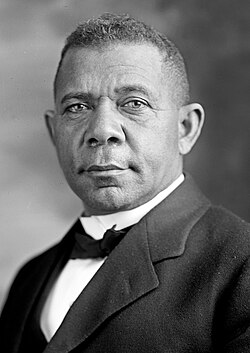
The Atlanta Compromise originated in a speech delivered by Washington to the Cotton States and International Exposition in Atlanta, Georgia, on September 18, 1895. Black involvement in the Exposition began in early 1895, when white business leaders from Georgia invited Washington to assist in delivering a presentation to a U.S. Congressional committee, seeking federal support for the event. The white members of the delegation were impressed with Washington's address to the committee and invited him to speak at the exposition when it was held later that year.
The master of ceremonies of the Cotton Exposition was former governor of Georgia Rufus Bullock, who introduced Washington by saying: "We have with us today a representative of Negro enterprise and Negro civilization." The address was delivered to a segregated audience of blacks and whites, and was delivered in less than ten minutes.
Washington summarized his proposal near the end of the address:
The wisest among my race understand that the agitation of questions of social equality is the extremest folly, and that progress in the enjoyment of all the privileges that will come to us must be the result of severe and constant struggle rather than of artificial forcing. No race that has anything to contribute to the markets of the world is long in any degree ostracized. It is important and right that all privileges of the law be ours, but it is vastly more important that we be prepared for the exercise of these privileges. The opportunity to earn a dollar in a factory just now is worth infinitely more than the opportunity to spend a dollar in an opera-house.
Upon the speech's conclusion, the whites in the audience gave Washington a standing ovation. Clark Howell, editor of The Atlanta Constitution, stood on the stage and proclaimed the speech to be "the beginning of a moral revolution in America." Washington was congratulated by many white leaders present in the audience, including former governor Bullock. The text of the speech was distributed to most major US newspapers via telegraph. A few days after the speech, Washington received a letter of congratulations from President Grover Cleveland. Washington and his proposal received praise from several major white-owned newspapers in the days following the speech.
Washington did not use the phrase "Atlanta Compromise" to describe his proposal. That phrase was coined by Du Bois eight years after the address in his 1903 essay "Of Mr. Booker T. Washington and Others", which was published in his book The Souls of Black Folk. The bargain underlying the Atlanta Compromise is also called "accommodation" or "accommodationism".
Elements

The Atlanta Compromise was Washington's solution to what was then called "the Negro problem": a phrase used to refer to the dismal economic and social conditions of blacks, and the tense relationship between blacks and whites in the post-Reconstruction South. The essence of the Compromise was a bargain: blacks would remain peaceful, tolerate segregation, refrain from demanding equal rights or holding political office, avoid college education, and provide a dependable workforce for Southern industry and agriculture. In return, Washington hoped that whites would offer job opportunities, permit blacks to own property and homes, build schools for children, and create vocational institutes to give blacks the skills needed in the Southern economy.
Washington's speech appealed to the white businessmen in the audience because it promised them a cooperative, peaceful, reliable workforce, particularly in the areas of industry, agriculture, business, and housekeeping. Addressing blacks, Washington encouraged them to focus on manual labor, and accept it as their fate for the near future, claiming that "No race can prosper till it learns that there is as much dignity in tilling a field as in writing a poem. It is at the bottom of life we must begin and not the top." Washington also urged Southern blacks to remain in their home states and avoid the temptation to move to Northern states, repeatedly emphasizing the phrase "Cast down your bucket where you are."

The Compromise promoted the construction or expansion of vocational schools (following the model of existing schools such as Tuskegee Institute and Hampton Institute) to produce nurses, teamsters, farmers, housekeepers, factory workers, repairmen, teachers, cooks, and other tradespeople that would support Southern agriculture and industry. The emphasis on industrial education came at the expense of the construction of new liberal-arts universities for Southern blacks: Southern whites were concerned that blacks with a liberal-arts education would be unwilling to work in jobs that required manual labor. Washington counted on white philanthropists to fund new schools for blacks. Washington's speech specifically applauded the Northern philanthropists who had provided funding for black schools during the Reconstruction era: "... the constant help that has come to our educational life not only from the Southern States, but especially from Northern philanthropists who have made their gifts a constant stream of blessing and encouragement."
The Atlanta Compromise accepted racial segregation across most aspects of life, including transportation, education, recreation, and social interaction; whites would have to associate with blacks only when necessary for work or commerce. Washington employed a simile to describe his acceptance of segregation: "In all things that are purely social we can be as separate as the fingers, yet one as the hand in all things essential to mutual progress."
Washington did not entirely reject civil rights and racial equality. Rather, he viewed them as long-term results that would be obtained only after blacks had demonstrated their worth through loyal, dedicated work within the Southern economy.
Reception by African Americans
After Washington proposed the Atlanta Compromise in 1895, he emerged as the preeminent leader of the African American community. Many of Washington's associates supported the Compromise, including Robert Moton, who would become the leader of the Tuskegee Institute upon Washington's death. The Compromise was also supported by many middle-class Southern blacks, especially teachers.
Many Northern intellectuals disagreed with the Compromise and felt that protest was a more effective solution to racism. One of the first recorded criticisms was published in December 1895 – just a few months after the speech – in a letter to the editor of The Christian Recorder newspaper: "What the Negro desires today is a Moses who will not lead him to the plow, for he knows the way there, but who will lead him to the point in this country where he can get all his manhood rights under the Constitution."
Content from Wikipedia, available under CC BY-SA 4.0. Read on Wikipedia
Read today's article