Augustus
Roman emperor from 27 BC to AD 14
| Augustus | |
|---|---|
| Princeps | |
 The Augustus of Prima Porta | |
| Roman emperor | |
| Reign | 16 January 27 BC – 19 August AD 14 |
| Successor | Tiberius |
| Born | Gaius Octavius 23 September 63 BC Rome |
Augustus (born Gaius Octavius; 23 September 63 BC – 19 August AD 14), also known as Octavian (Latin: Octavianus), was the founder of the Roman Empire and the first Roman emperor from 27 BC until his death in AD 14. The reign of Augustus initiated an imperial cult and an era of imperial peace (the Pax Romana or Pax Augusta) when the Roman world was largely free of armed conflict. The principate, a style of government in which the emperor showed nominal deference to the Senate, was established during his reign and lasted until the Crisis of the Third Century.
Octavian was born into an equestrian branch of the gens Octavia. Octavian's great-uncle, the dictator Julius Caesar, named him as his primary heir in his will, and after Caesar's assassination in 44 BC, Octavian inherited his estate and assumed his name. He fought for the loyalty of Caesar's legions. He was made a senator during a state emergency and seized power by marching on Rome in 43 BC, becoming its youngest elected consul. He, Mark Antony, and Marcus Lepidus formed a triumvirate regime with legally sanctioned powers to outlaw and oppose Caesar's assassins and their allies. Following their victory at the Battle of Philippi in 42 BC, the triumvirate divided the Roman Republic among themselves and ruled as de facto oligarchs. Competing ambitions eventually tore their alliance apart; Octavian had Lepidus exiled in 36 BC for opposing him in Sicily, while Marcus Agrippa, Octavian's naval commander, defeated Antony in Greece at the Battle of Actium in 31 BC. Antony and his wife Cleopatra, the Ptolemaic queen of Egypt, killed themselves during Octavian's invasion of Egypt, which then became Octavian's personal property.
After the demise of the triumvirate, Augustus reached an accord with the remaining Roman elite: he would restore the facade of a free republic, centered around the Senate, the executive magistrates and the legislative assemblies. But his control of the military and half of Rome's provinces meant he maintained autocratic power legitimized by his appointment as commander-in-chief of most Roman armies. To avoid the appearance of monarchy or dictatorship, he eventually refused to stand for reelection to the consulship, but the Senate granted him the powers of the tribunate and censorship and the titles princeps ('first citizen'), augustus ('the revered'), and pater patriae (lit. 'father of the country'), and named the month of August after him. After the death of Lepidus, Augustus also assumed the title of pontifex maximus ('supreme pontiff').
Augustus dramatically enlarged the Empire, annexing Egypt, Dalmatia, Pannonia, Noricum, and Raetia, expanding possessions in Africa, and completing the conquest of Hispania. His expansionism, however, suffered a major setback in Germania. Beyond the frontiers, he secured the empire with a buffer region of client states and negotiated peace treaties with the Parthian Empire and Kingdom of Kush. He reformed the Roman system of taxation and currency, developed networks of roads with an official courier system, established a standing professional army, established the Praetorian Guard as well as official police and fire-fighting services for the city of Rome, and renovated much of the city during his reign. Augustus was a writer and patron of poets such as Virgil, and has been featured in various works of art from ancient to modern times. He died in AD 14 at age 75 from natural causes, and the Senate posthumously deified him. Persistent rumors have claimed his wife Livia poisoned him. He was succeeded as emperor by his stepson and adoptive son Tiberius.
Name
Augustus (/ɔːˈɡʌstəs/ aw-GUST-əs) was known by many names throughout his life:
- Gaius Octavius: (/ɒkˈteɪviəs/ ok-TAY-vee-əs; Latin: [ˈɡaːiʊs ɔkˈtaːwiʊs]). According to Suetonius, Octavius received the cognomen Thurinus (Latin: [tʰuːˈriːnʊs], 'of Thurii') in his infancy to commemorate his father's victory over followers of Spartacus at Thurii. Marcus Junius Brutus, the assassin of Octavian's adoptive father Julius Caesar, rejected Octavian's claim to testamentary adoption by Caesar by referring to him as Octavius.
- Gaius Julius Caesar: After Julius Caesar named Octavius his heir in 44 BC, Octavius took Caesar's nomen and cognomen. Historians often distinguished him from the late Caesar by adding Octavianus (Latin: [ɔktaːwiˈaːnʊs]) after the name, denoting that he was a former member of the gens Octavia. There is no evidence that Augustus did this himself, although some of his contemporaries called him Gaius Octavius, Gaius Julius Caesar Octavianus, or "young Caesar". Historians usually refer to him as Octavian (/ɒkˈteɪviən/ ok-TAY-vee-ən) for the period between 44 and 27 BC.
- Imperator Caesar: Octavian's early coins and inscriptions all refer to him as Gaius Caesar, but by 38 BC he had replaced Gaius with the victory title imperator ('commander'). His family line continued the use of the name Caesar, a cognomen for one branch of the Julian family, and eventually this formed a standard imperial title.
- Imperator Caesar Augustus: In 27 BC the Senate granted him the honorific Augustus (Latin: [au̯ˈɡʊstʊs]) ('the revered'). Historians use this name, or its converse Augustus Caesar, to refer to him from 27 BC until his death in AD 14.
Early life

Octavian was born as Gaius Octavius in Rome on 23 September 63 BC, at a family property on the Palatine Hill. His father, Gaius Octavius, came from a moderately wealthy equestrian family of the gens Octavia. He ascended the cursus honorum and served as a proconsular governor of Macedonia. His family was from Velitrae, near Rome, where his son spent part of his childhood. The younger Octavius's mother, Atia, was a niece of Julius Caesar.
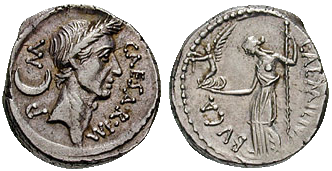
After Octavius's father died in 59 BC or 58 BC, his mother married Lucius Marcius Philippus, who was elected as consul in 56 BC. When Octavius's grandmother Julia, sister of Julius Caesar, died in 52 or 51 BC, Octavius delivered her funeral oration, his first public appearance. A Greek slave tutor named Sphaerus educated him in reading, writing, arithmetic, and Greek. Octavius later freed Sphaerus and gave him a state funeral in 40 BC. As a teenager, he studied philosophy under Areios of Alexandria and Athenodorus of Tarsus, Latin rhetoric under Marcus Epidius, and Greek rhetoric under Apollodorus of Pergamon.
Julius Caesar had formed an informal alliance with Pompey and Crassus in 60 BC, but by 49 BC it had fallen apart and Pompey and Caesar were fighting a protracted civil war. In 47 BC, after Octavius donned the toga virilis and became an adult citizen, Caesar had him elected as pontiff, replacing the slain Lucius Ahenobarbus. The following year, Octavius presided over the Greek games commemorating the opening of Caesar's Temple of Venus Genetrix. He wished to join Caesar's staff for the African campaign but gave way when his mother Atia protested over his poor health. Caesar allowed Octavius to proceed next to his chariot during his triumph celebrating the campaign and awarded Octavius with military decorations as if he had been present. In 45 BC Octavius traveled to Hispania to join Caesar's Spanish campaign against Pompey the Younger. On 13 September 45 BC Caesar deposited a new will with the Vestal Virgins naming Octavius as his principal heir.
Rise to power
Heir to Caesar
In 44 BC, Octavius was at Apollonia, Illyria, when Julius Caesar was made Rome's first dictator perpetuo ('dictator in perpetuity') in February, and then assassinated on the Ides of March (15 March). Octavius consulted with Caesar's officers in Macedonia before sailing for Italy to ascertain his political fortunes. Caesar had no living legitimate children under Roman law. His will made Octavius his main heir with the condition that he assume the dead dictator's name. After landing near Brundisium in southern Italy, Octavius received a copy of the will, which bequeathed him three-quarters of Caesar's estate. Against the advice of his stepfather Philippus, Octavius accepted Caesar's will on 8 May 44 BC. He purported that Caesar adopted him as his son and assumed the name Gaius Julius Caesar. His stepfather, Cicero, and other contemporaries referred to him as Octavianus.
Octavian could not rely on his limited funds to make a successful entry into politics. After a warm welcome by Caesar's soldiers at Brundisium, he demanded a portion of the funds allotted by Caesar for his eastern war against the Parthians. This amounted to 700 million sesterces stored at Brundisium, the staging ground in Italy for military operations in the east. Octavian made another bold move when, without official permission, he appropriated the annual tribute from Rome's province of Asia to Italy. He also began to recruit Caesar's veterans and men designated for the Parthian war. On his march to Rome through Italy, Octavian's presence and newly acquired riches won over many, including Caesar's veterans stationed in Campania. By June, he had gathered an army of 3,000 men, paying each a bonus of 500 denarii, which was more than twice a soldier's annual pay.
Growing tensions
Arriving to Rome on 6 May 44 BC, Octavian found consul Mark Antony, Caesar's former colleague, in an uneasy truce with Caesar's assassins. A general amnesty on 17 March pardoned the assassins in exchange for recognition of Caesar's legal acts. Soon afterwards, Antony succeeded in driving most of them out of Rome with an inflammatory eulogy at Caesar's funeral, mounting public opinion against the assassins.
Mark Antony amassed political support, but had lost the support of many Romans and Caesarians when he opposed the motion to elevate Caesar to divine status. Octavian challenged him as the leader of the Caesarians. To halt Octavian from dispersing 300 sesterces per capita to the urban plebs in accordance with Caesar's will, Antony refused to give Octavian the money due him as Caesar's heir. He also blocked the curiate assembly from hearing Octavian's attempts to legitimize his supposed adoption by Caesar, to have Caesar formally deified and to reinstate Caesar's golden throne for public view at games staged in April and June. During Caesar's victory games, Octavian distributed some of the funds in Caesar's will and combined this with his own money, enhancing his popularity while damaging Antony's.
During the summer of 44 BC, Octavian won the support of more veterans and also senators who perceived Antony as a threat to the state. Antony had lictors drag Octavian away from a hearing over the reinstatement of private property seized by Caesar in 49 BC. Octavian then claimed Antony threatened his life as retribution for distributing money to the plebs in Caesar's will. Caesar's veterans convinced Antony to publicly reconcile with Octavian in the Temple of Jupiter Optimus Maximus. Thereafter, Antony's bellicose edicts against the assassins Marcus Junius Brutus and Gaius Cassius Longinus alienated him from the moderate Caesarian senators, who feared a renewed civil war. In September, Marcus Tullius Cicero, now a political ally of Octavian, began to give a series of speeches portraying Antony as a threat to the Republic.
First conflict with Antony
With opinion in Rome turning against him and his consulship concluding, Antony illegally passed a law that would assign him the province of Cisalpine Gaul in northern Italy. Octavian meanwhile built up a private army in Italy by recruiting Caesarian veterans, and in early November entered Rome with this private force to challenge Antony. However, they vacated the city shortly afterwards, due to some veterans choosing to quit once it became clear they were involved in a Caesarian squabble rather than a revenge campaign against Caesar's assassins. Nevertheless, on 28 November, Octavian won over two of Antony's legions with the enticing offer of monetary gain. Antony then left Rome for Cisalpine Gaul, which was to be handed to him on 1 January 43 BC. However, the province had earlier been assigned to the assassin Decimus Junius Brutus Albinus, who now refused to yield to Antony. Antony besieged him at Mutina. This provided an opportunity for Octavian, whose private army was at hand.
Cicero defended Octavian against Antony's taunts, and had him inducted as a senator on 1 January 43 BC. Octavian was given the power to vote alongside the former consuls, the privilege to stand for election at an earlier age than usual, and imperium pro praetore which legitimized his command. Octavian accompanied the consuls to relieve the siege of Mutina. He assumed the fasces on 7 January, a date that he would later commemorate as the beginning of his public career. Antony retreated to Transalpine Gaul after his forces were defeated at the battles of Forum Gallorum and Mutina in April. Both consuls were killed, however, leaving Octavian in sole command of their armies. These victories earned him his first acclamation as imperator, a title reserved for victorious commanders.
Content from Wikipedia, available under CC BY-SA 4.0. Read on Wikipedia
Read today's article