Morris Park Aerodrome
Defunct airport in the Bronx, New York (1908–1909)
Morris Park Aerodrome | |
|---|---|
| |
| Summary | |
| Operator | Aeronautical Society of New York |
| Location | The Bronx, New York, US |
| Opened | 1908 |
| Closed | 1909 |
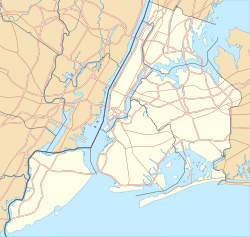  Morris Park Aerodrome Location in modern-day New York City |
The Morris Park Aerodrome was a short-lived airfield that became the Morris Park section of the Bronx, New York City, United States. In operation from 1908 to 1909, it was the first flying field in the nation, occupying the grounds of the former Morris Park Racecourse. The Aeronautical Society of New York, after a split from the Aero Club of America, leased the land in 1908 and used it as an aerodrome for two years until it was redeveloped for residential use.
The Society used the grounds for building and testing aircraft, and for putting on public exhibitions including major events in November 1908 and June 1909. The former, captured in an oil painting by Rudolph Dirks titled The Fledglings, included several glider flights by sixteen-year-old Laurence Lesh, culminating in a crash in which he was severely injured. The latter had flights by Glenn Curtiss in Golden Flyer, his motorized biplane, including the first demonstration of a stable flight around a closed course using ailerons for lateral control. The exhibitions also featured balloons, kites, helicopters, parachute jumps, and ground vehicles driven by propellers known as wind wagons.
Other projects worked on during the two years of operation included a biplane by Wilbur Kimball using eight propellers and a novel rudder system for lateral control, as well as a biplane from Frederick Schneider with three adjustable-pitch propellers. Stanley Beach and Charles Willard constructed what is believed to be the first monoplane flown in the United States. Joel T. Rice demonstrated a 100-foot (30 m) long dirigible using vectored thrust, capable of carrying 15 passengers.
The aerodrome ceased operations at the end of 1909, when the land was given over to residential development. The Society moved its operations to a larger facility on Long Island, later known as Roosevelt Field.
Origins
What the Society needed in the way of ground was not very easy to find. Free, open space over which to fly was not alone sufficient. It was equally, if not, indeed, still more necessary, that the grounds should be close to the city. For it was the ambition of the Society to have its grounds so near at hand that the distance should place no obstacle in the way even of the poorest inventor who wanted to run out to the workshops and devote his spare hours to the material realization of his ideas.
In 1905, the Aero Club of America, patterned after the Aero Club of France, was formed as an offshoot of the Automobile Club of America. Three years later, in response to sentiment that the Aero Club should be more active, president Cortlandt Field Bishop appointed a committee of aviation chaired by Albert Triaca to promote more work on airplanes. The committee, however, was unable to make any progress; Society chronicler Edward T. Tandy later wrote, "they found their efforts smothered by a cold, wet blanket of official objection. When they attempted to persevere, they were promptly stopped. The power that ruled that organization did not believe in aviation ... The doing of anything practical was not to be attempted."
Unsatisfied with the lack of progress being made by the committee, fifty members of the club split off on June 10, 1908, forming the Aeronautical Society of New York. Initial membership included Lee Burridge, Albert Triaca, Wilbur Kimball, Roger Whitman, William Hammer, Leo Stevens, Daniel Brine, and Stanley Beach. Burridge (who later became President of the Society) spoke of plans to acquire an airfield: "this society is going to stand for something tangible, practical, and it proposes to secure experimental grounds as soon as possible where men who have been working on problems of aeronautics will be enabled to try out their machines".

That summer, the Society examined several properties ranging from New Jersey to Long Island and ultimately selected the grounds of the former Morris Park Racecourse as the most suitable location. The racecourse had closed in 1904, after which the 372-acre (151 ha) property was used for automobile and motorcycle racing for a few years. The site was conveniently located near the recently opened West Farms Square subway station and a trolley stop, as well as a range of cafés and residences available at relatively low rents. Proximity to public transportation was considered essential, as it made the field accessible to all experimenters, not only the affluent. The location provided open spaces on level ground, several existing buildings which could be repurposed as workshops, and a larger building with well-tended landscaping to use as a clubhouse.
Morris Park Aerodrome (occasionally called the Morris Park Volery) was made available to members for the first time on the weekend of August 29 and 30, 1908. It was already known that the land was destined for residential development but a short-term lease was signed on or about August 31, running through December 31, 1909. By the following week, fences adjacent to the track were being removed to provide a clear, straight path of at least 0.62 miles (1.00 km); locations were being considered for the construction of a machine shop; and plans were underway for an exhibition at which "Freak machines will have a chance to show what they can do as well as the more orthodox types." A schedule of educational lectures was soon organized; these were presented in the clubhouse for the benefit of experimenters who were working on projects at the field.
The Woodmansten Inn, directly across Williams Bridge Road from the race track, provided a restaurant and sleeping facilities; an advertisement in the 1908 exhibition program offered dinner with wine for $3.00 (equivalent to $74 in 2024). The Inn had previously been a mansion on the estate of the Pearsall family and had been purchased in 1902 by the Westchester Racing Association as part of an unsuccessful attempt to increase attendance at the track. Tandy described it in his 1910 retrospective as "one of the best and most fashionable hotels of the city". The Woodmansten property was acquired by New York City in 1949 and is now the site of the Loretto Playground.
Field
Morris Park was the first flying field in the United States, although by the end of 1909, the aviation publication All the World's Airships by Fred Jane listed it as one of eight such facilities in the country. The primary purpose of the field was the construction of aircraft, although it was also used for flight instruction, hosting Albert Triaca's International School of Aeronautics. Within the first 12 months of operation, 24 full-sized heavier-than-air airplanes were constructed on the field, plus an assortment of gliders, airships, and a large number of scale models. Almost 25% of the Society membership held aircraft patents or were directly involved in the construction of aircraft at the field.
Lacking any hill high enough from which to launch a glider, the Society built two facilities for assisting in glider launches. The first was a catapult. The second was a larger structure of wooden construction, which was erected without first obtaining a building permit. After a glider spent an entire day atop the structure waiting for winds favorable for launching, city officials declared that the structure was a residence, and since it lacked both plumbing and a fire escape, condemned it, compelling it to be torn down.
Many of the aircraft built at Morris Park were failures, with aviation historians taking a pessimistic view of the members' skills. Preston Bassett described the Aeronautical Society as "a group of enthusiastic young men in New York City, all with plans for building their own machines [whose] enthusiasm far outran their ability to perform". Paul Glenshaw wrote, "The group could boast of few successes. Descriptions of the members' experiments included words like tree and fence, coupled with plunged and smashed."
1908 exhibition
On October 18, 1908, the first exhibition of the Society was announced for November 3 to coincide with Election Day. There were plans for two airplanes from the Aerial Experiment Association—June Bug and Silver Dart—to compete, a five-mile dirigible race, kites, and gliders; the kite contest was open to public school students with no entry fee. There were plans for one-, five-, and ten-mile motorcycle races sponsored by the Federation of American Motorcyclists and for the U.S. Weather Bureau to demonstrate the use of kites and captive balloons to collect atmospheric data. Lillian Todd, the only female member of the Society, was expected to show a "large model airplane" of her own design.
Admission to the exhibition was $0.50 (equivalent to $18 in 2025), with a five-cent subway ride from the heart of Manhattan taking 40 minutes. An estimated 20,000 spectators showed up, far exceeding expectations. Although several hundred people had volunteered to act as marshals (equipped with badges and sticks), a large number of people swarmed past the gate with only about 3,500 people having paid their admission fee. Tandy wrote that in the years since the race track had been in use, the fences had deteriorated and that "The payment for admission proved a matter of almost quixotic courtesy." In attendance was Grover Loening from the Columbia University Aero Club, which had just been formed the previous day. Loening would go on to earn in 1910 the first degree in aeronautical engineering issued by an American university.
Sixteen-year-old glider pilot Laurence J. Lesh was the highlight of the exhibition. A protégé of aviation pioneer Octave Chanute, Lesh was the first known aviator in Canada, having built and flown horse-drawn gliders as early as 1907 when he was fourteen years old. He became known for a record-setting 24-minute, 6.2-mile (10.0 km) flight towed by a motor boat on the St. Lawrence River.
Lesh broke his ankle when he crashed during his third flight of the day after reaching a maximum altitude of 70 feet (21 m) and traveling about 200 feet (61 m). One account attributed the cause of the crash to inexperience flying this model of glider which lacked the rudder used on his earlier designs. Another account blamed the crowd which got in his way while attempting to land. In any case, the injuries sustained in the crash sent Lesh to the hospital and took a year of rehabilitative therapy to fully recover.
The glider had been launched by rope tow behind a 1907 Thomas Flyer driven by Montague Roberts, one of the drivers for the team who had won the 1908 New York to Paris Race in that car. Montague had competed in a 1907 24-hour race held at Morris Park when it was used for automobile racing. Previous launch attempts on the day of the exhibition had used a tow horse; out of six tries, only two got off the ground, reaching an altitude of about 20 feet (6.1 m). Lesh had also planned to show a large box kite that day.
Wind wagon races
The exhibition included a contest for wheeled ground vehicles driven by propeller thrust, known as wind wagons. The New York Times described one of these as resembling "a huge tricycle with a propeller eight feet long in front and a gasoline motor behind". Inventors scheduled to show their wagons included astronomer William Pickering, aviation pioneer Glenn Curtiss, W. A. Custard, and Julian P. Thomas. According to Curtiss, the purpose of the wind wagon was to test the power of motors and the efficiency of propellers but it had no commercial value.
Content from Wikipedia, available under CC BY-SA 4.0. Read on Wikipedia
Read today's article