Cardinal-nephew
Cardinal appointed by a papal relative
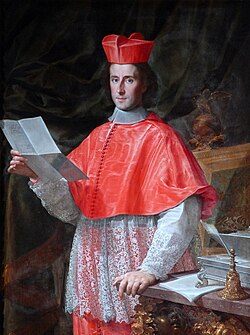
A cardinal-nephew (Latin: cardinalis nepos; Italian: cardinale nipote; Spanish: valido de su tío; Portuguese: cardeal-sobrinho; French: prince de fortune) was a cardinal elevated by a pope who was that cardinal's relative. The practice of creating cardinal-nephews originated in the Middle Ages and reached its apex during the 16th and 17th centuries. The last cardinal-nephew was named in 1689, and the practice was abolished in 1692. The word nepotism originally referred specifically to this practice when it appeared in the English language about 1669. From the middle of the Avignon Papacy (1309–1377) until Pope Innocent XII's anti-nepotism bull (a papal charter) Romanum decet pontificem (1692), a pope without a cardinal-nephew was the exception to the rule. Every Renaissance pope who created cardinals appointed a relative to the College of Cardinals, and the nephew was the most common choice.
The institution of the cardinal-nephew evolved over seven centuries, tracking developments in the history of the papacy and the styles of individual popes. From 1566 until 1692, a cardinal-nephew held the curial office of the Superintendent of the Ecclesiastical State, known as the Cardinal Nephew, and thus the terms are sometimes used interchangeably. The curial office of the Cardinal Nephew as well as the institution of the cardinal-nephew declined as the power of the Cardinal Secretary of State increased and the temporal power of popes decreased in the 17th and 18th centuries.
The list of cardinal-nephews includes at least fifteen, and possibly as many as nineteen, who became pope themselves (Gregory IX, Alexander IV, Adrian V, Gregory XI, Boniface IX, Innocent VII, Eugene IV, Paul II, Alexander VI, Pius III, Julius II, Leo X, Clement VII, Benedict XIII, and Pius VII; perhaps also John XIX and Benedict IX, if they were really promoted cardinals; as well as Innocent III and Benedict XII, if in fact they were related to their elevators); one antipope (John XXIII); and two or three saints (Charles Borromeo, Guarinus of Palestrina, and perhaps Anselm of Lucca, if he was really a cardinal).
History
Before 1566

The creation of cardinal-nephews predates the hierarchical preeminence of cardinals within the Roman Catholic Church, which grew out of the 1059 decree of Pope Nicholas II, In nomine Domini, which established cardinal bishops as the sole electors of the pope, with the consent of cardinal deacons and cardinal priests. The first known cardinal-nephew is Lottario (Latin: Loctarius), seniore, cousin of Pope Benedict VIII (1012–1024), elected circa 1015. Benedict VIII also elevated his brother Giovanni (the future Pope John XIX) and his cousin Teofilatto (the future Pope Benedict IX) as cardinal-deacons. The first known cardinal-nephew after 1059 is Anselm of Lucca, the nephew or brother of Pope Alexander II (1061–1073), although until the end of the 12th century the majority of the alleged cases of such appointments are dubious, either because the relationship between the pope and cardinal is not proven, or because the cardinalate of the papal kinsman is uncertain. However, it is beyond doubt that the promotions of papal relatives to the College of Cardinals were common in the 13th century.
According to historian John Bargrave, "by the Council of Bazill, Session 21, the number of cardinals was not to be above 24, and not any nephew of the Pope or of any cardinal was to be of that number. (Session 23.)"
Pope Clement VI (1342–1352) created more cardinal-nephews than any other pontiff, including six on September 20, 1342, the greatest number of cardinal-nephews elevated at one time. The capitulation of the 1464 papal conclave limited the pope it elected (Pope Paul II) to appointing one cardinal-nephew, along with other conditions designed to increase the power of the College of Cardinals and reduce the pope's ability to dilute that power.
The Fifth Council of the Lateran declared in 1514 that the care of relatives was to be commended, and the creation of cardinal-nephews was often recommended or justified based on the need to care for indigent family members. A cardinal-nephew could usually expect profitable appointments; for example, Alessandro Farnese, cardinal-nephew of Pope Paul III (1534–1549), held 64 benefices simultaneously in addition to the vice-chancellorship.
Pope Paul IV (1555–1559), in his old age, was said to have "fallen almost completely under the cardinal-nephew's influence"; Paul IV's cardinal-nephew, Carlo Carafa, was accused in August 1558 by a Theatine of seducing a Roman noblewoman, Plautila de' Massimi, who had come into possession of an inordinate amount of money and jewelry, but the accusations were dismissed by the pontiff. Saint Charles Borromeo, cardinal-nephew of Pope Pius IV (1559–1565), had ensured the subordination of the secretarius intimus to the Cardinal Nephew, which came to be sometimes known as the secretarius maior. Pius IV was notorious for nepotism: between 1561 and 1565 he transferred more than 350,000 scudi to his relatives.
1566–1692
Following the Council of Trent (1563), Pope Pius V (1566–1572) drew up the terms for the office of the Superintendent of the Ecclesiastical State, who was to handle the temporal affairs of the Papal States and the foreign relations of the Holy See. After abortively attempting to divide the duties of the Superintendent among four non-familial cardinals, Pius V acceded to the urgings of the College of Cardinals and his Spanish ambassador, and appointed his grandnephew, Michele Bonelli, as Superintendent, demarcating his duties with a papal bull of March 14, 1566. However, Pius V relentlessly avoided delegating any real autonomous power to Bonelli.
The Cardinal Nephew (also called cardinale padrone or Secretarius Papae et superintendens status ecclesiasticæ: "Superintendent of the Ecclesiastical State", Italian: Sopraintendente dello Stato Ecclesiastico) was an official legate of the Roman Curia, approximately equivalent to the Cardinal Secretary of State, which absorbed its functions after the office of Cardinal Nephew was abolished in 1692. The office has been likened by historians to a "prime minister", "alter ego", or "vice-pope". The Cardinal Nephew was generally among a pope's first cardinal creations, and his creature was traditionally accompanied by a salute from the guns of Castel Sant'Angelo.
Following the Avignon Papacy, the Cardinal Nephew was responsible for the spiritual and temporal governance of the Comtat Venaissin, where the Avignon Popes had resided; in 1475, Pope Sixtus IV raised the Diocese of Avignon to the rank of an archbishopric, to the benefit of his nephew Giuliano della Rovere.
The terms of the office of Cardinal Nephew were established by a papal brief developed and refined by Pius V's successors to Paul V (1605–1621). The Cardinal Nephew was also the correspondence liaison for all papal nuncios and gubernatorial legates, and the prefect for two congregations: the Consulta and the Congregazione del Buon Governo. The Cardinal Nephew was also the captain-general of the papal army and a "channel through which flowed benefices one way and gold the other".
However, these formal functions only came into force during the pontificates of unusually weak popes; most Cardinal Nephews were the de facto rubber stamp of the pontiff himself.
Although Pope Leo XI (1605) died before he was able to elevate his nephew, Roberto Ubaldini, Ubaldini was elevated by Leo XI's successor, Pope Paul V, in 1615.
Some historians consider Scipione Borghese, cardinal-nephew to Pope Paul V, to be the "prototypical representative" of a cardinal-nephew, unlike those before him, created to "provide for and oversee the permanent social and economic ascent of the reigning papal family into the ranks of the high Roman aristocracy". For example, in 1616, 24 of the 30 abbeys belonging to Borghese were rented out, a practice the Council of Trent had attempted to eliminate. A thorough financial analysis of Borghese's cardinalate by Volker Reinhardt (based on a series of extant account books) examines the strategies Borghese used to build up wealth during his uncle's pontificate and non-ecclesiastical assets before his uncle's death, which Volker considers to be exemplary of Baroque papal families. It is estimated that Paul V Borghese had transferred to his family approximately 4% of the total income of the Holy See during his pontificate. Borghese's personal revenues in 1610 were 153,000 scudi compared to the mere 4,900 scudi that constituted his entire family's income in 1592.
Pope Gregory XIV (1590–1591) began the practice of creating cardinal-nephews whose formal appointment coincided de facto with their nomination, and was thus separate from the ordinal process for creating cardinals, and when he fell ill, he authorized his cardinal-nephew, Paolo Emilio Sfondrato, to use the Fiat ut petitur, a power which was later diminished at the urging of the college. Paul V issued a motu proprio on April 30, 1618, formally bestowing on his cardinal-nephew the same authority Pope Clement VIII had given to Pietro Aldobrandini, beginning what historian Laurain-Portemer calls "l'age classique'" of nepotism.
Pope Gregory XV's (1621–1623) cardinal-nephew, Ludovico Ludovisi, the first cardinal-nephew known as il cardinale padrone ("the Cardinal boss"), accumulated a vast array of benefices: the bishopric of Bologna, 23 abbeys, the directorship of the Apostolic Signatura, as well as the offices of the vice-chancellor and high-chamberlain, and was able to have most of them redistributed among 17 of his kinsmen upon his death. These benefices and offices netted Ludovisi more than 200,000 scudi annually, and he is considered to have exercised "more unlimited authority" than any previous cardinal-nephew. Notably, cardinal-nephews were allowed to create facultas testandi to will the rewards of their benefices to secular family members. Gregory XV's successor, Urban VIII (1623–1644) convened two special committees of theologians, both of whom endorsed this practice.
As Fabio Chigi, I had a family. As Alexander VII I have none. You won't find my name anywhere in the baptismal registers of Siena.
— Pope Alexander VII, 1655, who appointed two cardinal-nephews in 1657
Not all Cardinal Nephews were cardinal-nephews in the strictest sense. In fact, papal historian Valérie Pirie considers not having a nephew a "tremendous asset for a would-be Pope" as it left the position open for an ally cardinal. For example, Pope Clement X gave the office to Cardinal Paoluzzi-Altieri, whose nephew had recently married Laura Caterina Altieri, the sole heiress of Clement X's family. Many historians consider Olimpia Maidalchini, the sister-in-law of Pope Innocent X (1644–1655), to have been a de facto Cardinal Nephew; the position was formally held by her son, Camillo Pamphili, then her nephew, Francesco Maidalchini (after Pamphili renounced his cardinalate in order to wed), and (after Francesco proved incompetent) Camillo Astalli, her cousin.
Popes often had only a few choices for the creation of a Cardinal Nephew. According to papal historian Frederic Baumgartner, Pope Sixtus V's (1585–1590) reign "started badly" because Alessandro Peretti di Montalto was "his only nephew eligible for the office, but he could hardly serve the Pope as a trustworthy confidant", causing several cardinals to refuse to attend his investiture. Another papal historian Ludwig von Pastor notes that "the misfortune of Pope Pamphili was that the only person in his family who would have had the qualities necessary to fill such a position was a woman".
Pope Innocent XI (1676–1689) despised the practice and only accepted his election as pope after the College of Cardinals consented to his plans for reform, which included a ban on nepotism. However, Innocent XI backed down after thrice failing to achieve the support of the majority of his cardinals for a bull banning nepotism, which had been tediously composed between 1677 and 1686. Innocent XI refused entreaties from within the papal court to bring his only nephew, Livio Odescalchi, the prince of Sirmio, to Rome, although he did elevate Carlo Stefano Anastasio Ciceri, a distant relative, cardinal on September 2, 1686. Innocent XI's successor, Pope Alexander VIII (1689–1691), was the last pope to create a Cardinal Nephew. Alexander VIII also undid another reform of Innocent XI by restoring the revenues of the former Chancery to the Vice-Chancellor, who was, at the time, his cardinal-nephew, Pietro Ottoboni. Edith Standen, a consultant to the Metropolitan Museum of Art, calls Ottoboni the "last and certainly not least magnificent example" of the "splendor of an extinct species, the Cardinal-Nephew".
Content from Wikipedia, available under CC BY-SA 4.0. Read on Wikipedia
Read today's article